
Any sound energy that makes us experience our own flow within, uplifting us, making us clap / dance, validating our feelings, making us still or making us journey along with the sound source, can be named as music.
Can silence be music? Of course, but the awareness that we must have to listen to that music which cannot be heard by our ears, requires a great deal of sadhana (practice).
For people moving through day to day life, music is associated with sound.
Music is created through a combination of frequency of sounds produced and mostly delivered in a rhythmic manner. Sruthi mAta, laya pitA – It is said that, Sruthi - the backdrop on top of which we sing that connects us to the spaciousness, is the mother and the rhythm that connects us to the time factor, is the father.
Music is a part of everyone's lives knowingly or unknowingly. The most common one in the present times is the “Popular” music or “Film” music.
Way back, in India, before Radio and Television came into existence, music was very much a part of temple rituals, family gatherings (poojas and marriages) or day to day working (folk songs) and so on.
Origin of Indian Classical Music however dates even further back into Vedic Age where Sama Veda was recited in a musical form. It is very interesting to see the evolution of Indian Classical music from Vedic Hymns to the present day Concert format.
Indian Music Experience Museum in Bangalore (a must visit for all musicians) has beautifully arranged the time lines of Indian classical music here - https://indianmusicexperience.org/blogs/the-evolution-of-indian-music/
As of October 2022, according to Hindu calendar, we are into the 5124th year in Kaliyuga which is 3102 BCE in terms of Gregorian calendar. The vedic period which was from 2500 – 500 BCE (some say from 1500 – 500 BCE) mainly saw music as Vedic Chants. The concept of seven notes in a scale also started emerging. It is amazing to see how this “seven” notes concept prevails in all music systems and not only just Indian Music. During the vedic period, the instruments Veena and Mridangam were used.
Then came a period between 500 BCE and 500 CE where musical treatise were being written for the first time by sages Bharata Muni (Natya Sastra) and Dattila (Dattilam). The Natya Sastra talked about all arts forms – Dance, Music (Vocal and Instrumental) and Theatre. 22 Sruthis and Gramas (Scales) were described along with the stress on Rasa Bhava Anubhava – the experience of using music to effectively to create a certain emotion in the audience. Dattilam written by Sage Datilla was entirely on music mentioning the 22 Sruthis, scales (swaras), sthana (base note), tonal framework (grama), arrangements of notes (murchana), combination of note sequences tanas or alankaras.
Then came the medieval period between 5th and 13th century AD. Matanga Muni introduced the word “Raga” and for the first time distinguished between “Classical” music and “Folk” music. As soon as the term “Raga” is introduced and if a composition is based on a raga, then it needs to follow the structure and aesthetics of that Raga. Folk music on the other hand is more free to use the notes in any which way to convey an expression or a theme.
In this same period, North India came under the influence of Persian and Central Asian culture and sufism got added to Indian music.
The 7th to 15th century AD was marked by bhakti movement and gave rise to compositions by saints Sri Tulasidas and Meera Bai. Sri Tulsidas was great devotee of Sri Rama and Meera Bai was a devote of Sri Krishna and both used music to express their love for their beloved Almighty in the form that they connected to.
This is the point where two distinct forms of Indian Classical Music started to develop – the Carnatic Classical (South Indian) and the Hindustani Classical (North Indian).
Between the 13th to 20th century AD, the Hindustani Classical Music saw the masters like Amir Khusro contibuting to Qawwali, Tarana, Khayal and and Raja Mansing Tomar contributing to Dhrupad. The Mughal period saw the genius of Tansen (whose brilliant music even evoked fire and rain – by connecting to the energies of the pancha bhootas) and then the Gharana system emerged. Thumri emerged. Use of Harmonium in many styles of Hindustani music emerged. The modern Hidustani Music period (20th century AD) owes its growth mainly to the contributions of VD Paluskar Ji and VN Bhatkhande Ji amongst many great masters.
Between the 12th and the 16th century AD, Carnatic Music saw the saints like Annamacharya (from Andhra region) and Purandara dasa (from Karnataka region) composing musical compositions as an extension of the earlier bhakti movement. Purandara Dasa is known as the Sangeetha Pitamaha (the great grandfather of music). He is also the one who formalised the curriculum of learning Carnatic Music, the system that we use for learning even today. On the musicology part (those that analyse and write about music), Sangeetha Sara by Vidyaranya Swami first introduced the idea of parent and child ragas. The Pre Trinity period (between 16th and 18th century AD), further saw the emergence of literature on Janaka and Janya Ragas by Ramamatya (Svaramela Kalanidhi) and Venkatamakhi (Chaturdandi prakashika). This period also saw saint Ramadasu of Andhra composing beautiful compositions full of bhakti rasa on Lord Sri Rama
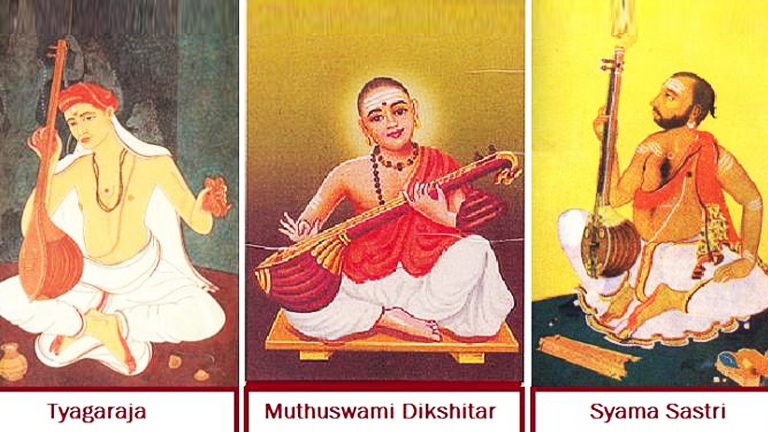
The technicalities of Carnatic Music grew leaps and bounds in the period of Trinity (18th and 19th century AD) when Sri Tyagaraja Swami, Sri Muthuswami Dikshitar and Sri Syama Sastri composed many many compositions in multitude of Ragas and Talas. Interestingly both Tyagaraja Swami and Muthuswami Dikshitar also composed simple nottuswaras based on C Major Western Scale and this was also the period when Baluswami Diskshitar introduced Violin (which was a western instrument till then) to the Carnatic Music Arena.
From 19th century to now, many books have been authored amongst which Sangeetha Sampradaya Pradarshini by Subbrama Dikshitar holds special mention and Ariyakudi Ramanuja Iyengar holds a special mention for his contributions towards today's Carnatic Classical Katcheri (Concert) format.
Why is all this important to us – the appreciators or learners of Indian Classical Music?
When the parts are operating independent of the knowledge of the whole or sometimes not even aware of being a part of a whole, the very purpose of this journey can be lost. We worldwide and mainly those who are connected to Indian Culture find ourselves in a very crucial phase where unless we are clear as to the purpose of appreciating or learning music, we cannot influence the next generation however hard we might try. If music is treated as only - yet another goal to achieve, yet another achievement to showcase, yet another stream to make our ego bloat in our musical brilliance – we can fail to recognise its main purpose – the one that connects our worldly self to our divine self. Indian Music is divine in nature but if approached with fear, judgement, ignorance, arrogance and power – it can only boost our egos or lower our self esteem and can cast a even bigger shadow on our divine self.
The above views / experience of the author is not shared from a preaching perspective but from a perspective of someone who was suddenly caught unaware, consumed by fear, ignorance and attachment and could not really connect the dots between inside energies and its outside propagation to her own loved ones. Coming from a musical family lineage made it even more difficult to simply accept certain situations. It was only through her children's innocent but true response (which definitely felt rebellious many times) and her spouse's deep connectivity and belief about one's own truth and journey, that made her work on herself to understand the purpose of music in a better way. Hence this is an attempt to share that understanding to those who also might be travelling on the same road and are open and looking for experiences to connect.
Our Indian Classical Music history shows that the purpose of music is to express and empathize and to connect to the Divine.
Further reading
1. https://indianmusicexperience.org/blogs/the-evolution-of-indian-music/
2. https://www.nios.ac.in/media/documents/Carnatic_Music_243/carnaticmusicbook1/ch1.pdf
3. https://riyazapp.com/singing-tips/summary-of-bharata-munis-natyashastra/
4. https://en.wikipedia.org/wiki/Natya_Shastra
5. https://en.wikipedia.org/wiki/Dattilam
6. https://en.wikipedia.org/wiki/Brihaddeshi
7. https://www.hindu-blog.com/2022/08/sangita-sara-of-vidyaranya.html
8. https://en.wikipedia.org/wiki/Svaramelakalanidhi
9. https://en.wikipedia.org/wiki/Chaturdandiprakashika
10.https://guruguha.org/the-birth-of-sangita-sampradaya-pradarshini-2/
Smt. Shobha Srinivasan
bhAratIya kalA saMsKruti prays and wishes that each of us in our music journey, in our own way, devote ourselves to this very purpose.
Smt. Seetha Chandrashekhar
12th May 2023
Oottukkadu Venkata Kavi's Saptaratna Kritis - Bhajanamrutha - Part 4
The context of this song is very similar to Thyagaraja’s Endaro Mahanubhavulu. In this composition Shri.Oottukkadu…
Read More
రచయిత : “అమృతవర్షిణి”
సంపుటి 1 సంచిక 7 ఏప్రిల్ 2023
'ఆ పాట - నా మాట'
ఏదైనా పాటకు సంగీతమా, సాహిత్యమా.. ఏది ముఖ్యం? నా దృష్టిలో ఏ పాటైనా…
Read More
Smt. Seetha Chandrashekhar
28th Mar 2023
Oottukkadu Venkata Kavi's Saptaratna Kritis - Bhajanamrutha - Part 3
The context of this song is very similar to Thyagaraja’s Endaro Mahanubhavulu. In this composition
…